public final K getKey() { return key; } public final V getValue() { return value; } public final String toString() { return key + "=" + value; }
public final int hashCode() { return Objects.hashCode(key) ^ Objects.hashCode(value); } //比如二进制 1001 ^ 1100 = 0101 //亦或,相同为为假,不同为真
public final V setValue(V newValue) { V oldValue = value; value = newValue; return oldValue; }
public final boolean equals(Object o) { if (o == this) return true; if (o instanceof Map.Entry) { Map.Entry<?,?> e = (Map.Entry<?,?>)o; if (Objects.equals(key, e.getKey()) && Objects.equals(value, e.getValue())) return true; } return false; } }
/** * 构造一个指定初始容量和加载因子的HashMap */ public HashMap( int initialCapacity, float loadFactor) { // 初始容量和加载因子合法校验 if (initialCapacity < 0) throw new IllegalArgumentException( "Illegal initial capacity: " + initialCapacity); if (initialCapacity > MAXIMUM_CAPACITY) initialCapacity = MAXIMUM_CAPACITY; if (loadFactor <= 0 || Float.isNaN(loadFactor)) throw new IllegalArgumentException( "Illegal load factor: " + loadFactor);
// Find a power of 2 >= initialCapacity // 确保容量为2的n次幂,是capacity为大于initialCapacity的最小的2的n次幂 int capacity = 1; while (capacity < initialCapacity) capacity <<= 1;
//构造一个指定初始容量和加载因子的HashMap public HashMap(int initialCapacity, float loadFactor) { if (initialCapacity < 0) // 初始容量和加载因子合法校验 throw new IllegalArgumentException("Illegal initial capacity: " + initialCapacity); if (initialCapacity > MAXIMUM_CAPACITY) //最大容量 initialCapacity = MAXIMUM_CAPACITY; if (loadFactor <= 0 || Float.isNaN(loadFactor)) throw new IllegalArgumentException("Illegal load factor: " + loadFactor); this.loadFactor = loadFactor; // 赋值加载因子 this.threshold = tableSizeFor(initialCapacity); // 赋值扩容临界值 }
//threshold是作为扩容的阈值而存在的,它是由负载银子决定的。下面的方法是返回 与给定数值最接近的2的n次方的值: static final int tableSizeFor(int cap) { int n = cap - 1; n |= n >>> 1; n |= n >>> 2; n |= n >>> 4; n |= n >>> 8; n |= n >>> 16; return (n < 0) ? 1 : (n >= MAXIMUM_CAPACITY) ? MAXIMUM_CAPACITY : n + 1; }
public HashMap() { this.loadFactor = DEFAULT_LOAD_FACTOR; // all other fields defaulted }
public HashMap(Map<? extends K, ? extends V> m) { this.loadFactor = DEFAULT_LOAD_FACTOR; putMapEntries(m, false); }
final void putMapEntries(Map<? extends K, ? extends V> m, boolean evict) { int s = m.size(); if (s > 0) { if (table == null) { // pre-size float ft = ((float)s / loadFactor) + 1.0F; int t = ((ft < (float)MAXIMUM_CAPACITY) ? (int)ft : MAXIMUM_CAPACITY); if (t > threshold) threshold = tableSizeFor(t); } else if (s > threshold) resize(); for (Map.Entry<? extends K, ? extends V> e : m.entrySet()) { K key = e.getKey(); V value = e.getValue(); putVal(hash(key), key, value, false, evict); } } }
public boolean containsValue(Object value) { // 若“value为null”,则调用containsNullValue()查找 if (value == null) return containsNullValue();
// 若“value不为null”,则查找HashMap中是否有值为value的节点。 Entry[] tab = table; for (int i = 0; i < tab.length ; i++) for (Entry e = tab[i] ; e != null ; e = e.next) if (value.equals(e.value)) return true; return false; }
containsNullValue() 的作用判断HashMap中是否包含“值为null”的元素。
1 2 3 4 5 6 7 8
private boolean containsNullValue() { Entry[] tab = table; for (int i = 0; i < tab.length ; i++) for (Entry e = tab[i] ; e != null ; e = e.next) if (e.value == null) return true; return false; }
// 返回一个“entry迭代器” Iterator<Map.Entry<K,V>> newEntryIterator() { return new EntryIterator(); }
// Entry的迭代器 private final class EntryIterator extends HashIterator<Map.Entry<K,V>> { public Map.Entry<K,V> next() { return nextEntry(); } }
// HashIterator是HashMap迭代器的抽象出来的父类,实现了公共了函数。 // 它包含“key迭代器(KeyIterator)”、“Value迭代器(ValueIterator)”和“Entry迭代器(EntryIterator)”3个子类。 private abstract class HashIterator<E> implements Iterator<E> { // 下一个元素 Entry<K,V> next; // expectedModCount用于实现fast-fail机制。 int expectedModCount; // 当前索引 int index; // 当前元素 Entry<K,V> current;
HashIterator() { expectedModCount = modCount; if (size > 0) { // advance to first entry Entry[] t = table; // 将next指向table中第一个不为null的元素。 // 这里利用了index的初始值为0,从0开始依次向后遍历,直到找到不为null的元素就退出循环。 while (index < t.length && (next = t[index++]) == null) ; } }
public final boolean hasNext() { return next != null; }
// 获取下一个元素 final Entry<K,V> nextEntry() { if (modCount != expectedModCount) throw new ConcurrentModificationException(); Entry<K,V> e = next; if (e == null) throw new NoSuchElementException();
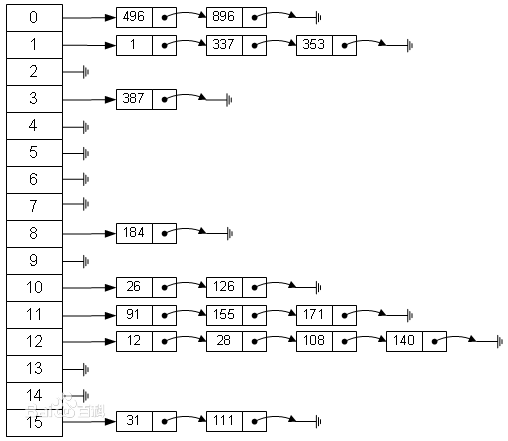
// 注意!!! // 一个Entry就是一个单向链表 // 若该Entry的下一个节点不为空,就将next指向下一个节点; // 否则,将next指向下一个链表(也是下一个Entry)的不为null的节点。 if ((next = e.next) == null) { Entry[] t = table; while (index < t.length && (next = t[index++]) == null) ; } current = e; return e; }
// 删除当前元素 public void remove() { if (current == null) throw new IllegalStateException(); if (modCount != expectedModCount) throw new ConcurrentModificationException(); Object k = current.key; current = null; HashMap.this.removeEntryForKey(k); expectedModCount = modCount; }
为了更好理解这里我们可以把这两个方法简化为 int index= key.hashCode()/table.length,以put中的方法为例可以这样替换
1 2 3 4
int hash = hash(key.hashCode());//计算hash int i = indexFor(hash, table.length);//计算在数组中的存储位置 //上面这两行可以这样简化 int i = key.key.hashCode()%table.length;
1 2 3 4 5 6 7 8 9 10
static int hash(int h) {
    // This function ensures that hashCodes that differ only by
    // constant multiples at each bit position have a bounded
    // number of collisions (approximately 8 at default load factor).
    h ^= (h >>> 20) ^ (h >>> 12);
    return h ^ (h >>> 7) ^ (h >>> 4);
}
static int indexFor(int h, int length) {
    return h & (length-1);
}
添加put方法:(1,'a'),(2,'b'),(3,'c'),(4,'d')
打印添加后的map{3=c, 2=b, 1=a, 4=d}
删除第四个4元素
打印map{3=c, 2=b, 1=a}
contains key 1 : true
contains value a : true
next : 3 - c
next : 2 - b
next : 1 - a
map is empty
static int hash(int h) {
        // This function ensures that hashCodes that differ only by
        // constant multiples at each bit position have a bounded
        // number of collisions (approximately 8 at default load factor).
        h ^= (h >>> 20) ^ (h >>> 12);
        return h ^ (h >>> 7) ^ (h >>> 4);
    }

 static int indexFor(int h, int length) {
        return h & (length-1);
    }